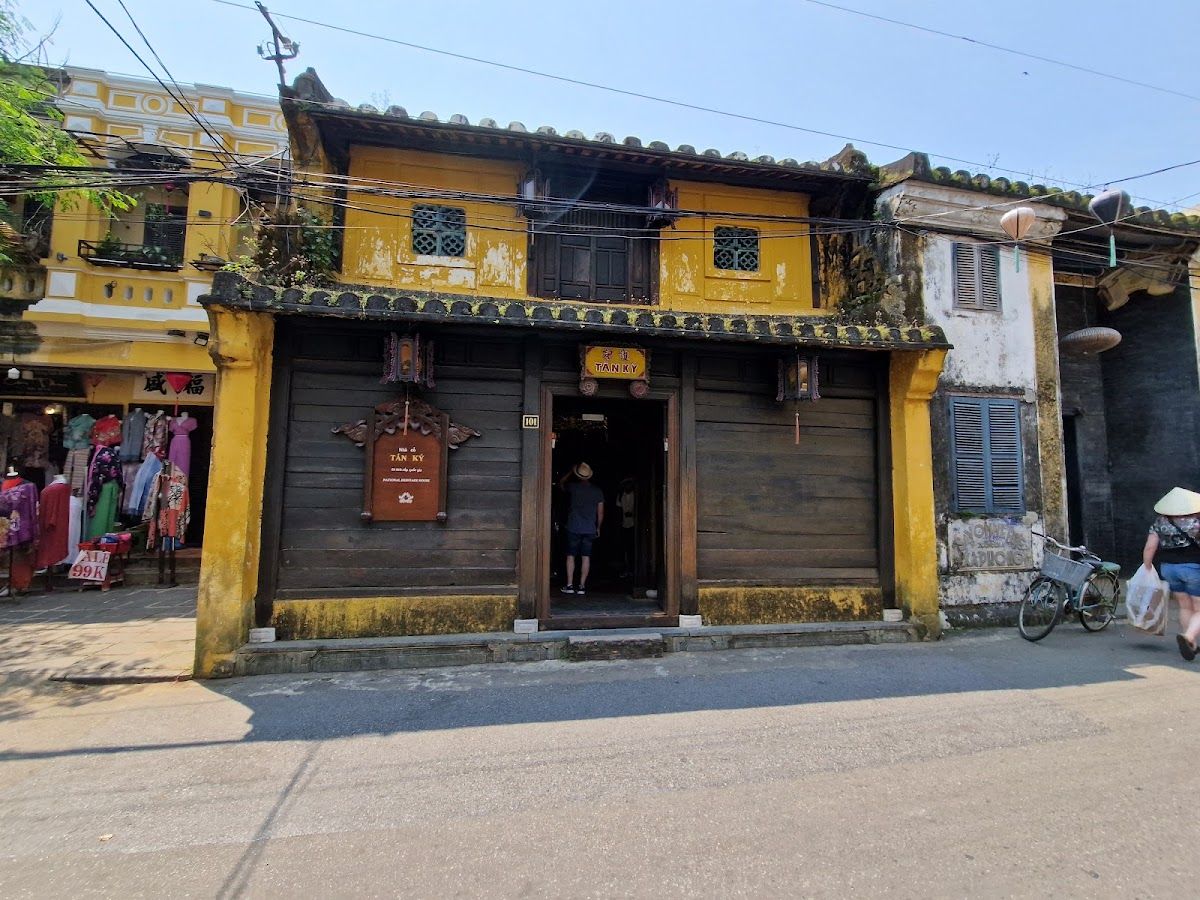

Hue is 100 km north of Da Nang — two and a half hours by train, three by road. Vietnam’s imperial capital until 1945: a walled citadel, royal tombs in the hills south of the city, a pagoda on the Perfume River, and food that is genuinely different from anything else in the country. Hue is the obvious history day trip from Da Nang.
The choice is simple: train for comfort, car or motorbike if you want the Hai Van Pass road. How you get there determines whether you see the pass, and missing it means missing one of the better road moments in central Vietnam.
Quick facts
- Train: ~₫100,000–200,000, 2h 28m, scenic mountain and coast views through Hai Van — the best default option
- Private car with driver: ~₫1,200,000–2,500,000 return for the vehicle, flexible stops, can include the pass road
- Open-tour bus: ~₫150,000–170,000 one-way via Sinh Tourist / similar, comfortable but goes through the tunnel, no pass
- Easy Rider motorbike tour: ~$51–58 USD one-way, 8 hours with stops, the pass is the whole point
- Hue Citadel entry: ₫200,000 adults / ₫40,000 children (7–12)
- Royal tombs: ₫150,000 each; combo tickets available
- Day trip verdict: feasible, but overnight is significantly better
Getting from Da Nang to Hue
Train: the best option for most people
The train between Da Nang and Hue takes about 2 hours 28 minutes on standard SE services. Hard seat runs ~₫100,000–105,000; soft seat (air-conditioned) is ₫130,000–200,000. No separate foreigner pricing — same fare for everyone. Berths exist but make no sense for a 2.5-hour trip.
The route is genuinely scenic. North of Da Nang, the line climbs through the Hai Van mountain range via a series of tunnels and viaducts — the sea opens up on your left, forested cliffs above you, the pass summit visible in good weather. It is not the same as riding the road over the top (you don’t stop, you don’t get the open sky), but it is not tunnel-darkness either. For sea views, sit on the left (west-facing) side leaving Da Nang. The approach into Hue along the Perfume River is a decent arrival.
The HD2 Heritage Train departs Da Nang around 7:50 am and arrives Hue at 11:05 am — convenient for a day trip. Other SE services run through the day. Check the Vietnam Railways website or ask your hotel to pull current times.
Best for: Anyone who wants a reliable, comfortable transfer with good scenery and doesn’t need to stop on the pass road.
Private car: most flexible
A private car with driver for the Da Nang–Hue round trip costs roughly ₫1,200,000–2,500,000 for the vehicle depending on size (4-seater vs 7-seater) and whether your driver takes the pass road or the tunnel. If you want to stop at the pass summit, Lang Co beach, and perhaps the Marble Mountains on the way back, a private car is the only option that accommodates all of it at your own pace.
Confirm before you book whether the driver will use the pass road (Quoc Lo 1) or the tunnel. Most default to the tunnel to save fuel and time. If the pass matters, say so explicitly — it adds 30–45 minutes each way.
Book through your hotel, a local operator, or Da Nang Transfer. For a small group (3–4 people), the per-person cost comes close to the Easy Rider price without the motorbike commitment.
Best for: Families, groups, or anyone who wants flexibility on stops without being on a motorbike.
Easy Rider motorbike tour: the pass is the point
An Easy Rider tour is a guided motorbike journey where you ride pillion behind a driver-guide. The Da Nang or Hoi An to Hue one-way run takes around 8 hours with stops — the Marble Mountains, the Hai Van Pass summit, Lang Co lagoon, fishing villages along the coast — and costs roughly $51–58 USD per person. Most operators offer one-way delivery (they drop you in Hue, you arrange a train or bus back), which is the sensible approach since doing 8 hours each way in one day is a lot.
The Hai Van Pass on a motorbike is different from any other version of it. The road is 21 km of switchbacks above the sea, with the Da Nang coastline and Son Tra Peninsula spread below you on the southern side and the Lang Co lagoon on the north. At the summit is a ruined gate from the Nguyen dynasty. On a clear morning, you stop, look down at both coasts, and understand why this road was the geographic divide between north and south Vietnam for centuries.
Check reviews before booking. Cheaper operators sometimes route through kickback restaurants, which adds dead time. Established operators — Easy Riders Vietnam, Central Vietnam Guide, similar — have enough track record that you can verify them on TripAdvisor.
Best for: Anyone who specifically wants the Hai Van Pass experience and is comfortable riding pillion on a motorbike for several hours.
Open-tour bus: budget, no pass
Sinh Tourist and similar open-tour operators run the Da Nang–Hue route for around ₫150,000–170,000 one-way. The bus is air-conditioned and comfortable. It goes through the Hai Van Tunnel, not the pass road. Journey time is 2.5–3 hours.
For a day trip, a morning departure puts you in Hue by around 11:30 am — workable but limits time in the city. The last comfortable return means leaving Hue by 4–5 pm. Confirm current schedules and prices when booking, as both shift seasonally.
Best for: Budget travellers doing a one-way move or those who don’t care about the road.
The Hai Van Pass: what it is and whether you’ll see it
The pass sits 20 km north of Da Nang. The road over it is 21 km long, climbing to around 496 m with sea on both sides at the summit. Since the Hai Van Tunnel opened in 2005, most regular traffic takes the underground bypass (toll: ₫35,000 for cars). The pass road is now used mainly by motorbikes, Easy Rider tours, and vehicles specifically seeking the scenic route.
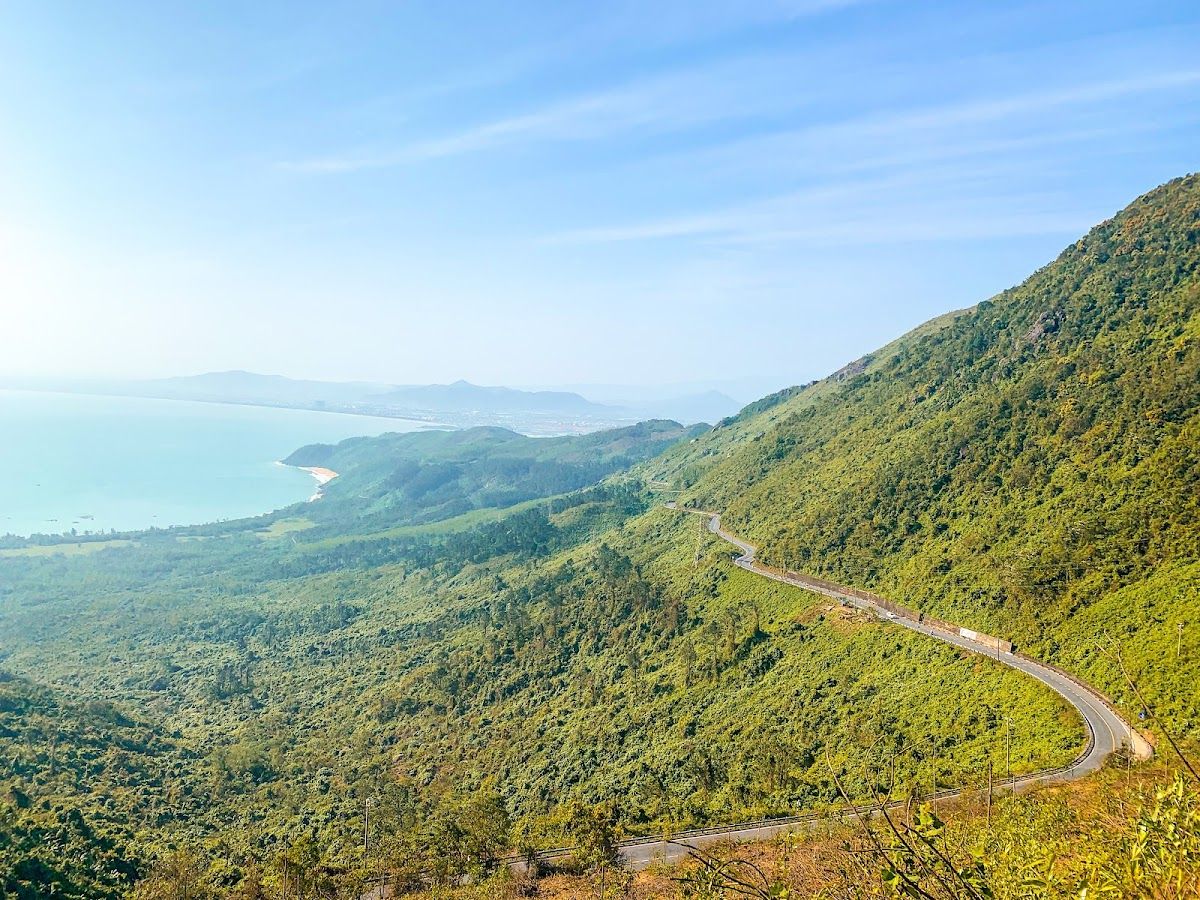
If you take a bus or a Grab, you go through the tunnel and see nothing of the pass. The train crosses the Hai Van mountain range via tunnels and rail viaducts — you get mountain and sea views, but you don’t stop at the summit or ride the open road. To actually drive the pass and stand at the top, you need a motorbike (Easy Rider tour or self-rented) or a private car driver instructed to take the road rather than the tunnel.
The pass road is narrow and not maintained to highway standard. Take it in clear weather — on a foggy or wet morning the views disappear and the road is genuinely slippery. If you arrive at the start of the climb and the cloud is sitting low, wait 30 minutes or take the tunnel. Confident motorbike riders handle it without drama in good conditions; it’s not technical riding.
Lang Co, the small beach town on the north side of the pass, is a reasonable stop for lunch or a swim if you’re in a private car with time to spare. It’s not worth a dedicated trip, but a bowl of noodles by the lagoon on the way through is pleasant.
In Hue: the Citadel
| Entry | ₫200,000 adults / ₫40,000 children (7–12) / free under 7 |
| Hours | 8:00 am – 5:30 pm daily |
| Time needed | 2–3 hours |
The Hue Citadel — formally the Imperial City, Đại Nội — is a walled complex along the Perfume River that served as the seat of the Nguyen dynasty from 1802 to 1945. The main entrance is Ngo Mon Gate, a five-arched structure facing south that was used for imperial ceremonies. From there the layout runs along a formal axis: Thai Hoa Palace (the audience hall), the Nine Dynastic Urns, the To Mieu temple complex, and various residences for the Queen Mother and consorts.
The Forbidden Purple City — the emperor’s private sanctum — was largely destroyed in the Tet Offensive of 1968. What’s left is open sky and partial walls. Don’t let that put you off; the surviving structures are genuinely impressive, the gardens are pleasant in the morning light, and the scale of the complex rewards unhurried walking.
Go early. By 10 am the site fills with tour groups. An 8 am entry in the morning cool, with a few hours before the heat sets in, is categorically better than an afternoon visit.
In Hue: the royal tombs
Seven Nguyen emperors are buried in the hills south of the city. Three are regularly visited:
| Tomb | Entry | Time needed | Character |
|---|---|---|---|
| Khai Dinh | ₫150,000 | 1–1.5 hours | Compact, dramatic, French-Vietnamese hybrid |
| Minh Mang | ₫150,000 | 1.5–2 hours | Classical symmetry, lakes, formal gardens |
| Tu Duc | ₫150,000 | 1.5–2 hours | Largest, forested, most serene |
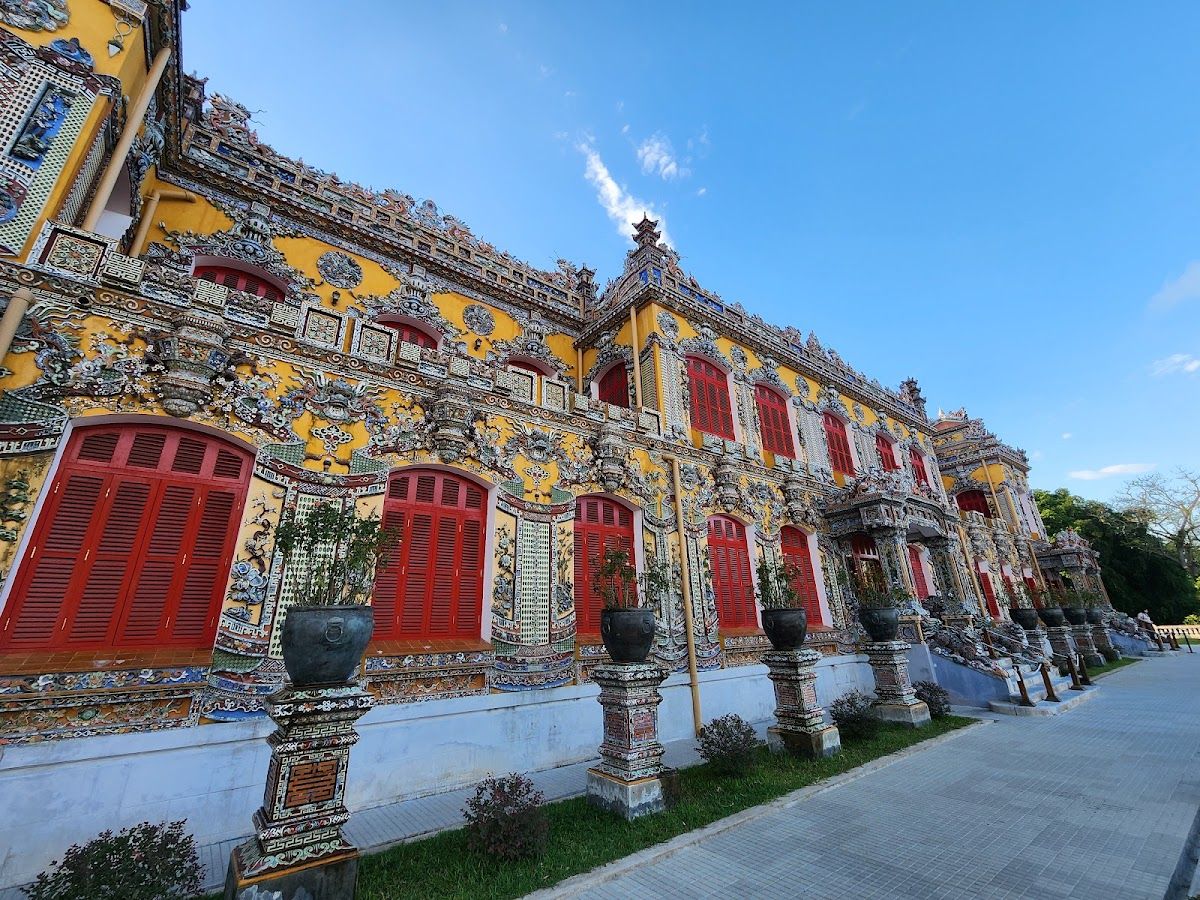
For a day trip, Khai Dinh is the one. It’s the smallest and the most visually arresting — a hillside mausoleum covered in ceramic and glass mosaics, mixing French Art Deco with Vietnamese imperial form in a way that looks unlike anything else in the country. You can cover it properly in under 90 minutes, which fits into a tight day trip schedule without sacrificing the Citadel.
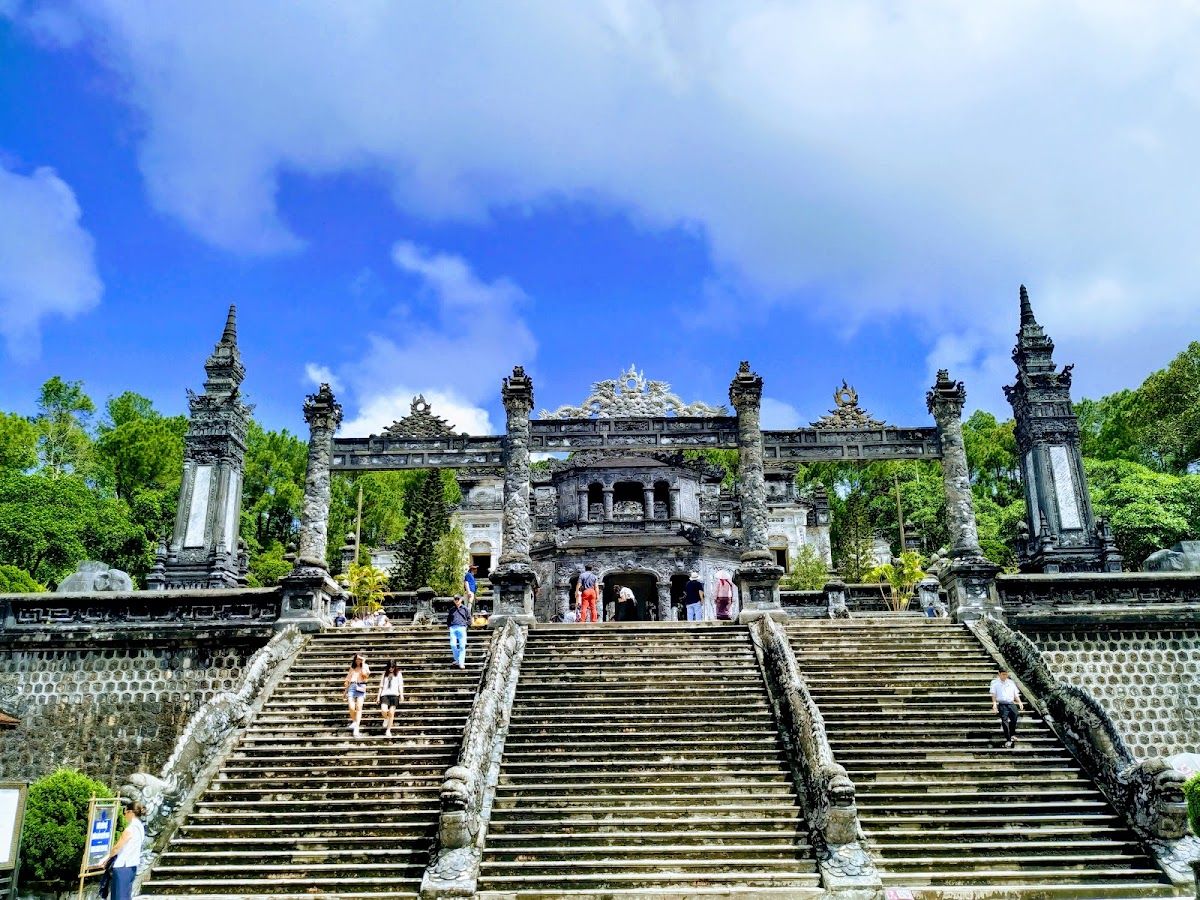
Minh Mang is the classical choice — formal gardens, pavilions reflected in lakes, the most architecturally coherent of the three. Worth it if you have a second tomb slot. Tu Duc is the largest and most atmospheric, but its scale makes it hard to rush.
Combo tickets: If you’re doing the Citadel plus Khai Dinh and Minh Mang, the combo 1 or 2 tickets (₫420,000) save ₫80,000 over individual entry. The Combo 4 (₫530,000) covers all four major sites.
The tombs are 5–8 km south of the Citadel. Grab a xe om (motorbike taxi) between sites — ₫30,000–50,000 per ride — or ask your driver to wait if you hired a private car.
In Hue: Thien Mu Pagoda
Free entry, open 8 am–6 pm. The pagoda sits on the Perfume River, about 4 km upstream from the Citadel. The Phuoc Duyen tower — seven octagonal storeys, built in 1844 — is the visual landmark of Hue. The grounds also contain the Austin car that carried Thich Quang Duc from the pagoda to Saigon in 1963, where he burned himself to protest the Diem government’s persecution of Buddhists. The car is still there, on display in a glass case.
Most drivers treating the Citadel as a half-day will offer Thien Mu as a natural pairing on the way. It adds 45 minutes including transit and is worth it if you have the time.
Dress code: Both Thien Mu and the Citadel have dress standards — shoulders and knees covered for entry into the main halls and pagoda. Light linen or a sarong works. Security at the Citadel has been enforcing this more consistently since 2024.
What to eat in Hue
Hue eats differently from Da Nang: sharper broths, more chilli, smaller plates, and a street food culture built around rice and fresh herbs. It’s one of the better reasons to visit the city.
Bún bò Huế — spicy beef and pork noodle soup with lemongrass, this is Hue’s signature dish. Thicker noodles than pho, a sharper broth, chili oil on the side. Local spots charge ₫30,000–45,000; tourist-facing restaurants push toward ₫60,000. Find a place with plastic stools and a queue out the door.
Cơm hến — baby clam rice with shrimp paste, roasted peanuts, sesame, bean sprouts, and fresh herbs. One of the stranger-looking dishes to Western eyes; one of the most interesting to eat. ₫20,000–35,000 at a proper local spot.
Bánh khoai — a small crispy rice-flour pancake filled with shrimp, pork, and bean sprouts, served with peanut-sesame dipping sauce. ₫30,000–50,000 per portion. Different from the larger bánh xèo in the south.
A full street food crawl covering breakfast and lunch costs under ₫200,000 per person. If you land in Hue before 10 am, start with bún bò Huế at a market stall before the Citadel. Save cơm hến for an early lunch before the afternoon tomb run.
Day trip vs overnight: the honest verdict
A day trip to Hue from Da Nang is feasible — but it’s tight, and nearly every traveller who has done both says overnight is a different experience.
The maths: 2.5 hours each way by train = 5 hours in transit. Leave Da Nang at 7 am, arrive Hue by 9:30 am, leave Hue at 4 pm to catch the late afternoon train back. That gives you 6.5 hours in the city. With efficient routing — Citadel first, Khai Dinh tomb after lunch, Thien Mu on the way back to the station — you can cover the main sights without feeling completely rushed.
What you lose on a day trip: the Citadel at opening (quieter and cooler), a second tomb, a slower food tour, the Perfume River at dusk, and any sense of the city at night when the light on the moat is worth seeing.
If your itinerary allows it, one night in Hue transforms it from a tick on a checklist to an actual place. A decent guestroom on or near Hung Vuong Street runs ₫400,000–700,000 per night. The Vietnamese food scene at night in the Pham Ngu Lao area is a different thing from the tourist corridor.
If you must do it as a day trip: take the early train, move with purpose, pick one tomb, and eat well.
Sample day trip itinerary
| Time | Activity |
|---|---|
| 7:50 am | Board HD2 Heritage Train at Da Nang station |
| 11:05 am | Arrive Hue, Grab to the Citadel (~₫40,000, 10 min) |
| 11:15 am | Citadel entry (₫200,000) — 2.5 hours |
| 1:45 pm | Lunch near Dong Ba Market — bún bò Huế |
| 3:00 pm | Grab to Khai Dinh Tomb (₫150,000) — 1.5 hours |
| 4:30 pm | Return Grab to Hue station |
| 5:00 pm | Board SE6 or SE8 train back to Da Nang |
| 7:30 pm | Arrive Da Nang |
Note: the HD2 morning service makes this schedule clean. Verify current departure times on the Vietnam Railways website before booking — schedules shift seasonally. If HD2 is full, take the next available SE service and compress the afternoon accordingly.
This schedule works with no slack. If the train is 20 minutes late, compress lunch. Don’t add a second tomb unless you’re prepared to skip the food stop.
For more on where this trip fits into a longer stay, see the Da Nang day trips overview or the 3-day Da Nang itinerary for how to sequence it against Ba Na Hills and Hoi An.
Getting to the train station from My Khe or central Da Nang: Grab runs ₫40,000–80,000. The station is on Hai Phong Road, about 10 minutes from the beach strip. More on getting around: Da Nang transport guide.
FAQ
How do I get from Da Nang to Hue? Train (₫70,000–200,000, 2h 28m) is the best default. Private car gives you flexibility on stops including the pass. Open-tour buses (₫119,000) are cheap but use the tunnel. Easy Rider motorbike tours ($51–58 USD one-way) take the Hai Van Pass road and stop along the coast — the full experience, but a long day.
How much is entry to the Hue Citadel? ₫200,000 adults, ₫40,000 for children 7–12, free under 7. Open 8 am–5:30 pm daily. Allow 2–3 hours.
Which royal tomb is best for a day trip? Khai Dinh. Compact, visually extraordinary, and takes 1–1.5 hours. Entry ₫150,000. For a second tomb, add Minh Mang.
Is Hue worth a day trip? Yes — but overnight is better. A day trip with an early train gives you 6.5 hours in the city. That covers the Citadel, one tomb, and a proper lunch. Two tombs, Thien Mu, and a slower food crawl need a night.
Does the train cross the Hai Van Pass? The train crosses the Hai Van mountain range via tunnels and rail viaducts with mountain and sea views — but it doesn’t use the open road or stop at the summit. For the full pass experience, you need a motorbike (Easy Rider or self-rented) or a private car taking the mountain road.
What food should I try in Hue? Bún bò Huế (spicy beef noodle soup, ₫30,000–45,000), cơm hến (baby clam rice, ₫20,000–35,000), and bánh khoai (crispy rice pancake, ₫30,000–50,000). A full street food breakfast and lunch costs under ₫200,000 per person.